
Author: Rob

  • Is your website ready for Agentic Browsing? Lighthouse will check.

    Is your website ready for Agentic Browsing? Lighthouse will check.

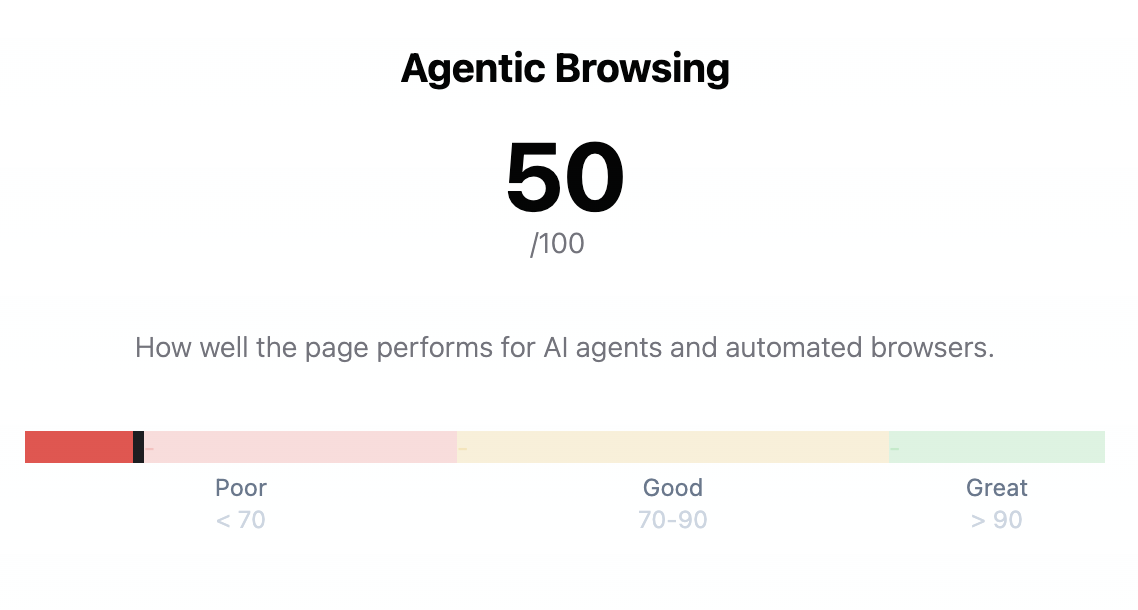
    Google’s Lighthouse now grades your website on how well AI agents can use it, and most operators haven’t seen the grade. Last week, the Lighthouse team shipped a new top-level category called Agentic Browsing which measures how well the page performs for AI agents and automated browsers.

    Agentic visitors are growing fast. Cloudflare’s April 2026 Radar data put website bot traffic at 32% of all HTTP requests, with AI crawlers at 22% of that bot share.

    Let’s take a deeper look at the Agentic Browsing category, then we’ll show you how to see these results in ONIK’s Scorecard.

    can an AI agent use your page? four new audits

    This new Agentic Browsing category includes four checks:

    • Agent accessibility
      Uses the browser’s accessibility tree to help agents understand page elements, such as buttons, links, labels, and decorative content. If screen readers rely on it, agents likely will too.
    • Layout stability
      Reuses Cumulative Layout Shift. Shifting layouts are annoying for humans, but they can break agents completely: an agent may target one element, then click the wrong place after the page moves.
    • WebMCP
      An emerging W3C draft that lets websites expose callable tools directly to AI agents, such as search_products or check_inventory, instead of forcing agents to guess their way through forms, screenshots, or APIs. WebMCP helps agents interact with your site, and will be best used in user-visible, human-in-the-loop tasks on a live webpage.
    • llms.txt
      An LLM friendly site summary at /llms.txt tells the LLM what the site does, what matters, and what is off-limits. Similar to robots.txt but for LLMs, this file summarizes key content to help LLMs understand and navigate your site.

    Accessibility and Layout Stability are two well known standards in UX and can negatively impact both human and agentic visitors. Said another way, a good healthy website is good for humans and AI. Additionally, AI can use other traditional tools like robots.txt, sitemaps, and your regular content.

    New Tools for AI:

    WebMCP and llms.txt are both emerging standards and are not yet widely adopted. Fewer than 0.5% of the pages we test are using the llms.txt, and even fewer have WebMCP. However; the opportunity is now. LLLMs.txt is very easy to implement, with WordPress plugin options available. (We use RankMath’s llms.txt feature, Yoast SEO has this feature too).

    WebMCP is designed to really help Agentic interactions, and is currently in early preview status in Chrome. Here are a couple of great resources if you’d like to learn more:

    Get your Agentic Browsing scorecard

    The Agentic Browsing audits are now available in every ONIK scorecard alongside Performance, Accessibility, SEO, and Best Practices. ONIK Scorecard is an easy way to explore your score, and monitor it for changes.

    Insights and Actions are delivered directly to your inbox and in your scorecard dashboard.
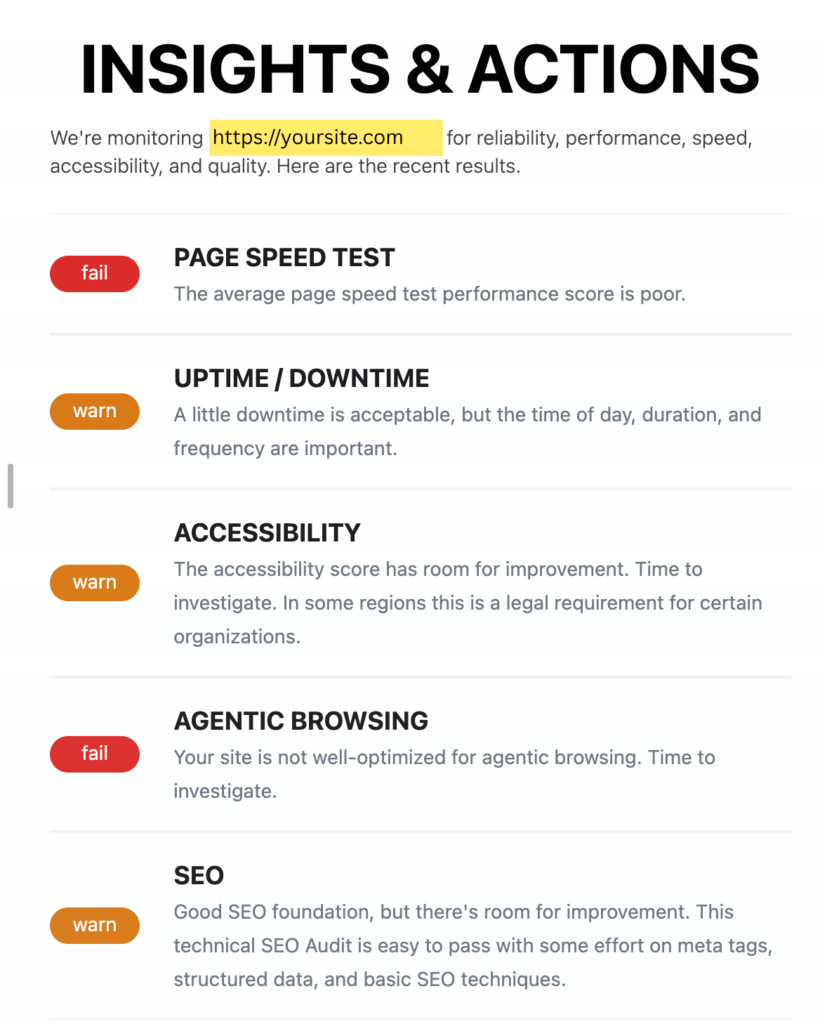
    Insights and Actions for a sample site showing failing Page Speed and Agentic Browsing Tests.  Warnings for Uptime/Downtime, Accessibility, and SEO.

    In addition, you also see a trackable Agentic Browsing score (/100) based on the features you choose to implement. If you choose not to implement WebMCP or LLMS.txt there’s no penalty.
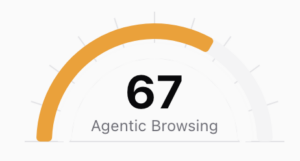
    Agentic Browsing score of 67 / 100

    Lastly, Drill deep into any failed audit to understand why it failed and how to improve.

    Deep dive on Agentic Browsing Warning showing the Accessibility tree is not well formed.

    What makes a site agent-friendly?

    This Build agent-friendly websites article on web.dev does an excellent job explaining how agents view websites, and shares why visual stability and accessibility are also core to AI agents.

    • Agents need clean machine-readable signals. They use screenshots, HTML, and the accessibility tree to understand what a page contains and what actions are possible.
    • Visual design alone is not enough. Complex hover states, shifting layouts, transparent overlays, and non-semantic elements can make a site confusing or unusable for agents. (And humans)
    • Semantic HTML matters more than ever. Use real buttons, links, labels, roles, and form associations so agents can reliably understand intent.
    • Stable layouts reduce broken actions. If buttons, forms, or key content move around after load, agents may misread the page or click the wrong thing.
    • Agent-ready is human-ready. The same improvements that help agents also improve accessibility, usability, and overall site quality.

    In addition, there are other AI Bot and Agent controls you may wish to implement. These are not yet tested by lighthouse, but are also emerging practices.

    • AI Bot Specific Rules in Robots.txt can control which pages AI bots can access, and if content can be used for searching and/or training.
    • Markdown Negotiation – Serve site content as markdown when requested, making it easier for LLMs to parse and read.

    NEXT STEPS

    What we’re stoked about is making sites agent friendly ultimately makes them a better experience for humans. Here are some steps you can take to improve both.

  • From Complexity to Clarity: The Operational Mind Behind Onik

    How Co-Founder Jeremy Francis built a career on fixing what actually matters—and brought that mindset to web performance.

    Most organizations don’t have a performance problem.

    They have a clarity problem.

    Too many tools.
    Too many metrics.
    Too many competing priorities.

    And no clear answer to a simple question:

    What actually needs to be fixed?

    This is where Jeremy Francis operates best.

    Built in Complexity

    Jeremy didn’t start in tech.

    He started in global retail—an environment where operations are constant, pressure is real, and inefficiencies show up fast. It’s where he developed the instinct that would define his career:

    Focus on what matters. Ignore the rest.

    When he moved into tech at Rebel.com, that instinct sharpened. Over more than a decade, Jeremy worked across nearly every operational function—logistics, project management, HR, financial systems, and cost efficiency—ultimately becoming COO.

    But more importantly, he became the person teams relied on when things weren’t working.

    Not to diagnose everything.

    To fix the right things.

    Making Performance Visible

    At Assent, Jeremy led Revenue Operations across Customer Success and Professional Services—two areas where performance is often felt, but not clearly measured.

    He built systems that changed that.

    By developing and visualizing KPIs around customer health, churn, and retention (NRR/GRR), Jeremy helped teams see what was actually happening beneath the surface. Executives got clarity. Teams got direction. Decisions got sharper.

    He also restructured CRM systems and standardized the customer journey—turning fragmented processes into something measurable, repeatable, and improvable.

    Because in Jeremy’s world, if you can’t see it clearly, you can’t fix it properly.

    Operational Discipline at Scale

    Earlier, at Heroic, Jeremy focused on building the operational backbone of the business.

    He developed financial forecasting models and reporting frameworks.
    Improved data hygiene across the organization.
    Built new datasets around customer behavior, product usage, and subscriptions.

    At the same time, he supported HR systems and internal policies—ensuring the team itself could operate at a high level.

    It’s not flashy work.

    But it’s the difference between organizations that react—and those that operate with control.

    Bringing That Mindset to Performance

    At ONIK, Jeremy applies that same discipline to a space that is often anything but disciplined: web performance.

    Most teams are overwhelmed by it.

    They run audits.
    They see scores.
    They get lists of issues.

    And then they stall—because they don’t know what actually matters.

    Jeremy changes that.

    He cuts through the noise.
    Identifies the highest-impact issues.
    And focuses teams on fixing what will actually move the needle.

    Not everything.

    Just the things that matter most.

    The Operator’s Perspective

    Jeremy doesn’t think about performance as a technical checklist.

    He sees it as an operational problem:

    • What’s causing the most friction?
    • What’s having the biggest impact?
    • What can be fixed quickly and effectively?

    Because performance doesn’t improve through awareness.

    It improves through focused action.

    The Bottom Line

    Most teams don’t need more data.

    They need better decisions.

    And better decisions come from clarity—about what matters, what doesn’t, and where to focus.

    That’s what Jeremy brings to ONIK.

    Not more complexity.

    Just a clear path to fixing what’s actually slowing you down.

    Wanna chat with Jeremy? Connect with him on LinkedIn.

  • Thank You, Invest Ottawa: How IO IGNITION Helped ONIK Build

    Last year, ONIK participated in Invest Ottawa’s IGNITION program—an intensive 10-week bootcamp designed to validate a tech startup idea and build a real business foundation. Invest Ottawa has backed ONIK in practical ways during the program and long after it ended. This is a short thank you—and a clear account of what changed because of it.

    THE BOOTSTRAPPING ONIK Challenge

    Bootstrapping a business is exciting. Its also fast, relentless, but it can be isolating. It can get lonely.

    In the summer before we joined IO, Jeremy and I were starting to feel it. We’d always worked with teams, and now we we only had each other. We had gaps to fill:

    • Community: Founders don’t just need motivation, they need a cohort of peers and fans to keep momentum and enthusiasm up.
    • Support: We’re experienced builders, but startups present new problems. The Invest Ottawa coaches became our knowledgeable and reliable team.
    • Network: New startups need discussion, input and feedback. The IO networking events helped us meet potential customers, partners, peers, and more.

    The IGNITION Program

    IGNITION is the trailhead of Invest Ottawa’s Venture Path. It’s built to help founders and new companies map the road ahead and avoid common pitfalls. The weekly rhythm is simple: show up, learn, share, and take it all in. We spent every Thursday afternoon with IO coaches, trainers, and our cohort of startup peers.

    For me, three lessons really stood out.

    • Customer discovery – Be an investigator: fewer guesses, more signal. Ryan Paul Gibson trains founders to think like an investigator during customer discovery interviews.
    • A live demo sales call in front of the cohort: slightly brutal, but very supportive. Wayne Selman played the part of curious customer for a mock sales call in front of he whole group. After this, pitching one-to-one is easy.
    • Using curiosity to gain insights: Andrew Milne showed us how to use curiosity to get directly to what matters. As curious as I thought I was, Andrew showed me there is room to be more curious.

    And the curriculum is unapologetically foundational: lean startup methodology, legal/accounting/banking basics, lean product development, sales and growth, funding roadmap (non-dilutive vs. dilutive), marketing/online presence, and pitching.

    Pulling It all Together for the Pitch Finale

    The program culminates in a Pitch Finale—pitching live in front of a large audience (judges, peers, community, friends, family). The two-minute time constraint is unforgiving—and that’s the point. It forces clarity. This is a nerve-wracking challenge, even experienced presenters. I was floored by how supportive everyone was in sharing kind words, hugs, and cheers.

    Every company in the cohort is in their own stage of the journey, and faced their own challenges. The bravery and resiliency stood out more than any outcome. The group was excited to see everyone grow.

    The amazing io Support continues

    Since IGNITION, Invest Ottawa has continued to support ONIK with introductions, coaching, media, and access to events. The team at IO are rabid fans of their startup graduates, and it shows. Most recently, Invest Ottawa invited us to participate in the IO showcase at the SaaS North Conference.

    Paying It Forward

    I’ve recommended Invest Ottawa IGNITION to most founders and small businesses—not out of obligation, but because it’s genuinely an awesome program. If you’re building and want structure, accountability, and a community that will challenge you, it’s worth a serious look. IGNITION runs quarterly and accepts applications throughout the year.

    I’d be happy to chat with you about our experience.

    A huge thank you to Abby, Erin, Nick, Andrew, Laurie, and the broader coaching and mentor community. You all showed up to help, and it did not go unnoticed.