-
From the Field: Agentic Browsing Is the Weakest Score We’re Seeing
Agentic Browsing is still early, but we are starting to see a clear pattern in the websites we test.
At ONIK, we monitor websites across several areas, including uptime, response time, performance, accessibility, SEO, best practices, and Agentic Browsing. That gives us a useful view into how websites are performing beyond a one-time audit or a single page speed test.
We have already written about what Agentic Browsing is, why Google Lighthouse now checks for it, and why it may push accessibility standards forward. This article is a little different. This one is about what we are seeing in the field.
Across the thousands of URLs monitored in ONIK, we reviewed the 7-day average Agentic Browsing scores to better understand how prepared websites are for AI agents and automated browsers. The results showed a clear gap.
The average Agentic Browsing score was only 40.7/100.
That gap is the story and also represents the biggest opportunity. It suggests that many websites may look fine through traditional testing, but still may not be easy for AI agents or automated browsers to understand, navigate, or interact with confidently.
Why this matters now
AI traffic is already here, and it is on the rise.
Cloudflare reported that AI crawlers represented about 20% of Verified Bot traffic in 2025, while search engine crawlers represented about 40%. Cloudflare also reported sustained growth in ChatGPT-User traffic, which is generated when ChatGPT visits pages in response to user requests.
Imperva reported that automated traffic surpassed human traffic in 2024, accounting for 51% of all web traffic, with bad bots making up 37%.
HUMAN Security reported that monthly AI-driven traffic grew 187% from January to December 2025, while traffic from AI agents and agentic browsers grew 7,851% year over year.
Those numbers are not all measuring the exact same thing. A crawler collecting content is different from an AI agent trying to complete a form, compare vendors, book an appointment, or check out on behalf of a user. But that distinction is exactly why this matters.
The web is not only being indexed anymore. It is increasingly being interpreted, summarized, navigated, and acted on by software. As that shift continues, website readiness will need to include more than speed, uptime, and traditional accessibility checks. It will also need to include whether an agent can understand what a page is, what actions are available, and how to complete them reliably.
What Agentic Browsing can do for a visitor
When people hear “AI agents,” it can sound abstract. But on a website, the use cases are practical.
An agent may read a site to find information, answer a question, or collect key details for a user. That could mean finding pricing, comparing service options, checking availability, summarizing a policy, or pulling together key information from a long page.
It may also complete simple interactions. An agent could use a search field, fill out a contact form, submit an expression of interest, or help a visitor find the right next step.
Over time, those interactions may become more complex. Agents may help users register for events, configure a service, purchase a product, submit a support ticket, update account information, or complete a multi-step workflow.
For that to work well, the website needs to provide more than content. It needs structure. It needs clear labels, predictable actions, understandable forms, and pages that communicate meaning in a way software can interpret.
That is where many websites are not ready yet.
The weakest category was Agentic Browsing
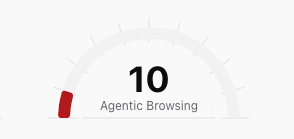
Across the thousands of URLs we reviewed, Agentic Browsing was the weakest category by a wide margin.
The average Agentic Browsing score was just 40.7. Looking deeper into the sample, over 70% of URLs tested had an Agentic Browsing score below 50. About two-thirds scored poorly, below 40, while less than 10% scored 70 or higher.
This does not mean those websites are broken. It does not mean they are slow. It does not mean they are unusable. It means that, when evaluated through an Agentic Browsing lens, many pages are not providing enough structure, clarity, or machine-readable context for agents to understand and interact with them confidently.
That is not especially surprising. Agentic Browsing is a newer category. Standards like WebMCP and llms.txt are still emerging, and most websites were not built with agent-driven browsing in mind. Still, the size of the gap is meaningful.
It shows that agent-readiness may become a separate layer of website quality, not something that can simply be assumed because a site already performs well elsewhere.
Strong scores do not always mean agent-ready
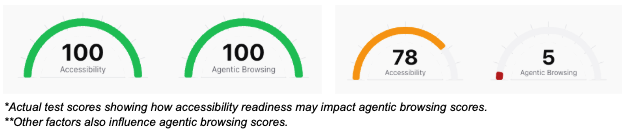
One of the more useful findings was that strong performance and accessibility scores did not always translate into strong Agentic Browsing scores.
We saw many pages with strong performance scores, strong accessibility scores, or both, that still scored poorly for Agentic Browsing. That is probably the strongest takeaway from this review: a website can be fast, accessible, and still be poorly prepared for agent-driven interaction.
That does not make the existing work less valuable. A fast, accessible website is still a better website. It simply shows that Agentic Browsing is adding a new layer to how website readiness should be evaluated.
Performance, accessibility, and agent-readiness are connected, but they are not the same thing. A page can load quickly and still be difficult for an automated browser to interpret. It may have unclear buttons, weak labels, non-semantic page elements, confusing form structures, or interactions that rely heavily on visual context.
We explored the connection between Agentic Browsing and accessibility in more detail in our earlier article on how Agentic Browsing may push accessibility standards forward. But the data shows the overlap is not complete. Agentic Browsing builds on performance and accessibility, while also exposing gaps those scores may not fully capture on their own.
What this means for website owners
For website owners and operators, this matters because AI agents are likely to become part of how users research services, compare options, complete forms, book appointments, make purchases, and interact with websites more generally.
Gartner has projected that by 2028, 33% of enterprise software applications will include agentic AI, up from less than 1% in 2024. It also predicts that at least 15% of day-to-day work decisions will be made autonomously through agentic AI by 2028.
That does not mean every website interaction is about to become agent-driven overnight. It does suggest that agents are moving from demos and experiments into the tools people use to get work done.
As that happens, websites will increasingly need to be understandable not only to people, but also to the systems acting on their behalf.
The practical takeaway is not that every website needs to chase every emerging AI standard immediately. The better starting point is to understand where your site may already be creating friction.
Are key pages structured clearly? Are forms properly labeled? Are buttons and links understandable without relying only on visual context? Does the page make its purpose clear in the structure of the site, not just in the design? Can an automated browser understand what actions are available and what step should come next?
These are not only agent questions. They are website quality questions. That is why we continue to come back to the idea that Agent-ready = Human-ready.
Next Steps
What we’re stoked about is making sites agent friendly ultimately makes them a better experience for humans. Here are some steps you can take to improve both.
- Sign-up to ONIK Scorecard to see your Agentic Browsing score, Insights, and Actions.
- Learn more about building agent-friendly websites, implementing llms.txt, and WebMCP
-
Agentic Browsing Might Finally Make Accessibility Impossible to Ignore
For years, website accessibility has been treated like a separate project. Important, but later. Something for legal, compliance, or the next redesign. That was always the wrong way to think about it. Accessibility is not a side project. It is website quality. Agentic Browsing may finally make that harder to ignore.
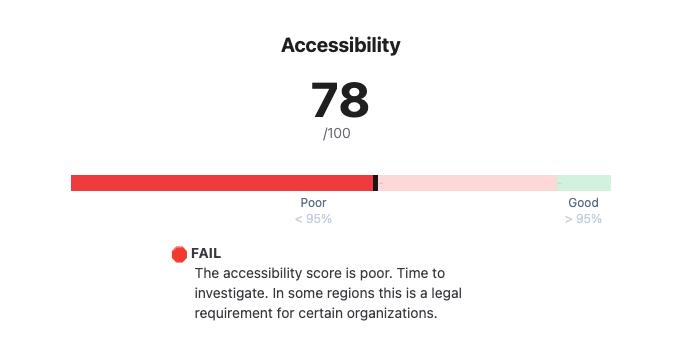
We know this because the majority of the sites we test fail basic accessibility checks.
LightHouse Implements Agentic Browser Testing
Google’s Lighthouse now includes an Agentic Browsing category that looks at how well a page performs for AI agents and automated browsers. One of those checks is agent accessibility, which uses the browser’s accessibility tree to help agents understand page elements like buttons, links, labels, and decorative content.
That matters because the accessibility tree is already used by screen readers and assistive technology. The same structure that helps a person navigate a website may also help an AI agent understand what the page contains and what actions are possible. That does not make accessibility new, it makes the business case louder.
AI Agents Need the Same Signals Accessibility Depends On
AI agents do not browse websites the same way people do. They do not interpret a page based on visual design alone, and they cannot always “figure it out” because something looks obvious on screen.
- They need structure.
- They need signals.
- They need the page to explain itself in ways machines can understand.
That means real buttons, real links, clear labels, logical headings, stable layouts, and forms that properly describe what they are asking for. These are not new ideas. They are core parts of accessible, well-built websites.
For years, accessibility standards have pushed teams toward cleaner, more semantic, more understandable websites. Agentic browsing points in the same direction.
Pretty Is Not the Same as Understandable
Websites can look polished and still be difficult to use. This has always been true for people, and it may become increasingly true for agents as well.
- A button that is really a styled <div>.
- A form field with no proper label.
- A menu that only works on hover.
- A product card that looks obvious visually, but gives machines very little structure to work with.
- A page that shifts after loading and moves key actions out from under the user.
Nothing looks broken. But the site is harder to understand.
That is where accessibility, performance, and agentic browsing start to overlap. The problem is not only whether the page exists or whether it looks good. The problem is whether people, tools, and machines can reliably understand and interact with it.
Agent-Ready Is Human-Ready
The most important takeaway is simple: making a site easier for agents often means making it better for humans too.
Cleaner HTML helps agents understand the page, but it also helps assistive technology. Stable layouts help agents avoid clicking the wrong thing, but they also stop users from losing their place. Clear labels help agents understand forms, but they also help real people complete them with less friction.
This is not about optimizing for robots instead of people. It is about recognizing that good websites are readable, stable, accessible, and clear. For everyone.
Accessibility May Become an AI Readiness Issue
A lot of teams still think about accessibility primarily as a compliance requirement. That is part of the story, but it is not the whole story.
Accessibility also affects whether your website can be understood by people, search engines, assistive technology, automated testing tools, and now AI agents. If agents become part of how people research services, compare vendors, book appointments, make purchases, or summarize options, then inaccessible websites may face a new kind of visibility problem.
Not because the website is offline. Not because the brand is weak. But because the site is difficult for machines to interpret and act on. That creates friction, and friction has a cost.
The Standards Are Not New
There is a temptation to treat Agentic Browsing like a brand new category. In some ways, it is. WebMCP is emerging. llms.txt is still early. AI-specific crawling rules are still taking shape. But the foundation is not new. Semantic HTML, accessible labels, stable layouts, clear navigation, and good page structure have been best practices for years. The difference is that AI agents may give organizations another reason to finally care.
Accessibility was already the right thing to do. Agentic browsing may make it harder to ignore.
What to Do Next
Start with the fundamentals.
- Use real HTML elements.
- Label forms properly.
- Keep layouts stable.
- Make buttons and links clear.
- Structure content with logical headings.
- Avoid hiding critical actions behind visual tricks.
- Test accessibility regularly and monitor changes over time.
Then look at the emerging agentic standards. llms.txt may be a simple place to start. WebMCP may matter more as agent interactions mature. Robots.txt rules for AI crawlers may become part of your content strategy. But none of that replaces the basics. Because the basics are what make your website usable in the first place.
The Bigger Picture
Agentic browsing does not change why accessibility matters. It expands who — and what — depends on it.
The web is moving toward a world where people are not the only ones trying to understand your website.
- Assistive technology already does.
- Search engines already do.
- Automated tools already do.
- AI agents increasingly will.
So the question is not just whether your website is accessible. The question is whether your website can be understood. Because if it cannot, the problem is bigger than compliance. It affects visibility, usability, performance, trust, and eventually revenue.
Agent-ready is human-ready. The companies that understand that early will build better websites for everyone.
Next Steps
What we’re stoked about is making sites agent friendly ultimately makes them a better experience for humans. Here are some steps you can take to improve both.
- Sign-up to ONIK Scorecard to see your Agentic Browsing score, Insights, and Actions.
- Learn more about building agent-friendly websites, implementing llms.txt, and WebMCP
-
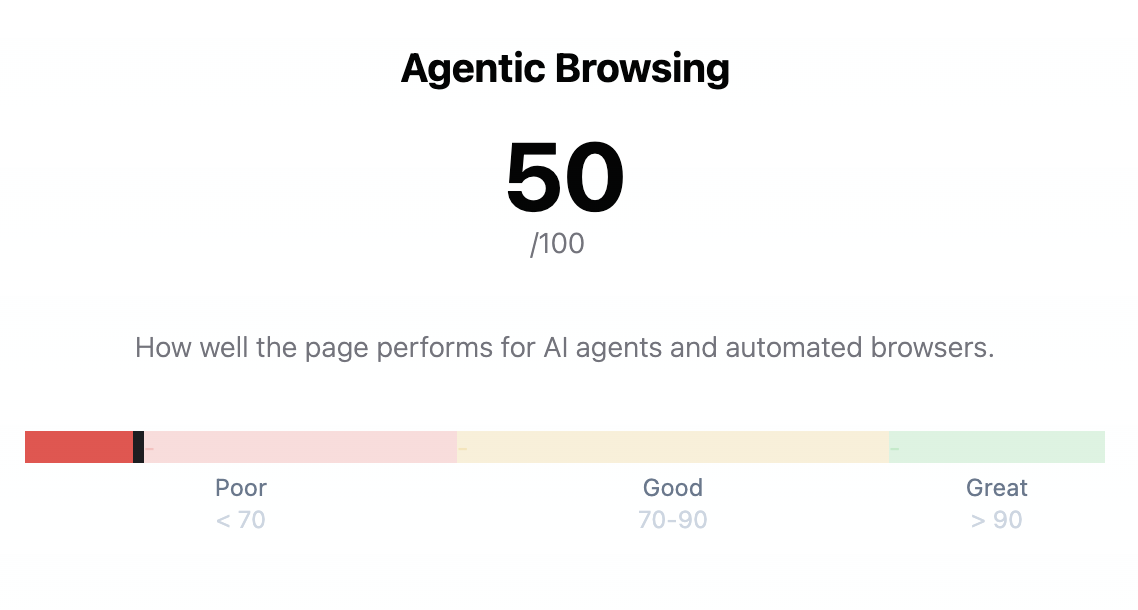
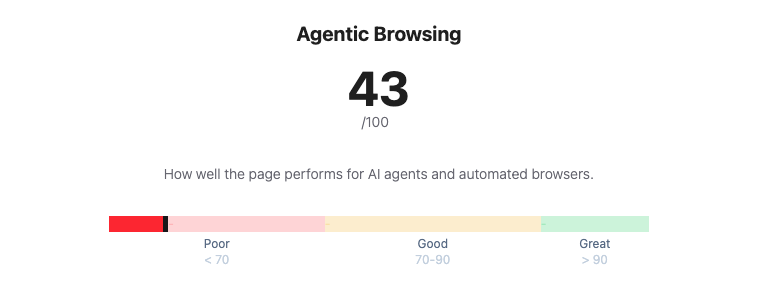
Is your website ready for Agentic Browsing? It’s easy to check.
Google’s Lighthouse now grades your website on how well AI agents can use it, and most operators haven’t seen the grade. Last week, the Lighthouse team shipped a new top-level category called Agentic Browsing which measures how well the page performs for AI agents and automated browsers.
Agentic visitors are growing fast. Cloudflare’s April 2026 Radar data put website bot traffic at 32% of all HTTP requests, with AI crawlers at 22% of that bot share.
Let’s take a deeper look at the Agentic Browsing category, then we’ll show you how to see these results in ONIK’s Scorecard.
can an AI agent use your page? four new audits
This new Agentic Browsing category includes four checks:
- Agent accessibility
Uses the browser’s accessibility tree to help agents understand page elements, such as buttons, links, labels, and decorative content. If screen readers rely on it, agents likely will too. - Layout stability
Reuses Cumulative Layout Shift. Shifting layouts are annoying for humans, but they can break agents completely: an agent may target one element, then click the wrong place after the page moves. - WebMCP
An emerging W3C draft that lets websites expose callable tools directly to AI agents, such assearch_productsorcheck_inventory, instead of forcing agents to guess their way through forms, screenshots, or APIs. WebMCP helps agents interact with your site, and will be best used in user-visible, human-in-the-loop tasks on a live webpage. - llms.txt
An LLM friendly site summary at/llms.txttells the LLM what the site does, what matters, and what is off-limits. Similar to robots.txt but for LLMs, this file summarizes key content to help LLMs understand and navigate your site.
Accessibility and Layout Stability are two well known standards in UX and can negatively impact both human and agentic visitors. Said another way, a good healthy website is good for humans and AI. Additionally, AI can use other traditional tools like robots.txt, sitemaps, and your regular content.
New Tools for AI:
WebMCP and llms.txt are both emerging standards and are not yet widely adopted. Fewer than 0.5% of the pages we test are using the llms.txt, and even fewer have WebMCP. However; the opportunity is now. LLLMs.txt is very easy to implement, with WordPress plugin options available. (We use RankMath’s llms.txt feature, Yoast SEO has this feature too).
WebMCP is designed to really help Agentic interactions, and is currently in early preview status in Chrome. Here are a couple of great resources if you’d like to learn more:
- WebMCP in action: Sarah Drasner has prepared an awesome WebMCP overview and demo site.
- If YouTube is more your thing, Build your website for the Agentic Era by Kasper Kulikowski from Google IO is a great presentation
Get your Agentic Browsing scorecard
The Agentic Browsing audits are now available in every ONIK scorecard alongside Performance, Accessibility, SEO, and Best Practices. ONIK Scorecard is an easy way to explore your score, and monitor it for changes.
Insights and Actions are delivered directly to your inbox and in your scorecard dashboard.
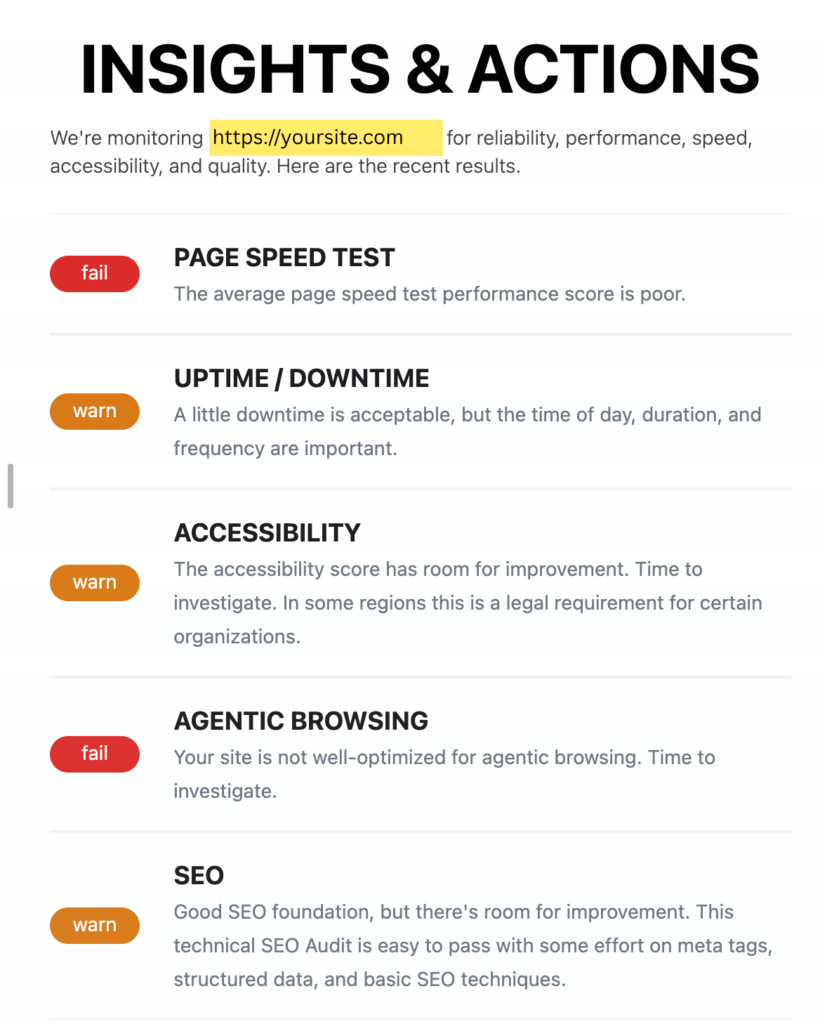
In addition, you also see a trackable Agentic Browsing score (/100) based on the features you choose to implement. If you choose not to implement WebMCP or LLMS.txt there’s no penalty.
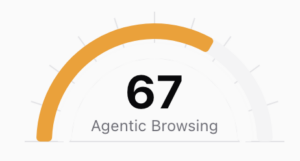
Lastly, Drill deep into any failed audit to understand why it failed and how to improve.

What makes a site agent-friendly?
This Build agent-friendly websites article on web.dev does an excellent job explaining how agents view websites, and shares why visual stability and accessibility are also core to AI agents.
- Agents need clean machine-readable signals. They use screenshots, HTML, and the accessibility tree to understand what a page contains and what actions are possible.
- Visual design alone is not enough. Complex hover states, shifting layouts, transparent overlays, and non-semantic elements can make a site confusing or unusable for agents. (And humans)
- Semantic HTML matters more than ever. Use real buttons, links, labels, roles, and form associations so agents can reliably understand intent.
- Stable layouts reduce broken actions. If buttons, forms, or key content move around after load, agents may misread the page or click the wrong thing.
- Agent-ready is human-ready. The same improvements that help agents also improve accessibility, usability, and overall site quality.
In addition, there are other AI Bot and Agent controls you may wish to implement. These are not yet tested by lighthouse, but are also emerging practices.
- AI Bot Specific Rules in Robots.txt can control which pages AI bots can access, and if content can be used for searching and/or training.
- Markdown Negotiation – Serve site content as markdown when requested, making it easier for LLMs to parse and read.
NEXT STEPS
What we’re stoked about is making sites agent friendly ultimately makes them a better experience for humans. Here are some steps you can take to improve both.
- Sign-up to ONIK Scorecard to see your Agentic Browsing score, Insights, and Actions.
- Learn more about building agent-friendly websites, implementing llms.txt, and WebMCP
- Agent accessibility
-
From Complexity to Clarity: The Operational Mind Behind Onik
How Co-Founder Jeremy Francis built a career on fixing what actually matters—and brought that mindset to web performance.
Most organizations don’t have a performance problem.
They have a clarity problem.
Too many tools.
Too many metrics.
Too many competing priorities.And no clear answer to a simple question:
What actually needs to be fixed?
This is where Jeremy Francis operates best.
Built in Complexity
Jeremy didn’t start in tech.
He started in global retail—an environment where operations are constant, pressure is real, and inefficiencies show up fast. It’s where he developed the instinct that would define his career:
Focus on what matters. Ignore the rest.
When he moved into tech at Rebel.com, that instinct sharpened. Over more than a decade, Jeremy worked across nearly every operational function—logistics, project management, HR, financial systems, and cost efficiency—ultimately becoming COO.
But more importantly, he became the person teams relied on when things weren’t working.
Not to diagnose everything.
To fix the right things.Making Performance Visible
At Assent, Jeremy led Revenue Operations across Customer Success and Professional Services—two areas where performance is often felt, but not clearly measured.
He built systems that changed that.
By developing and visualizing KPIs around customer health, churn, and retention (NRR/GRR), Jeremy helped teams see what was actually happening beneath the surface. Executives got clarity. Teams got direction. Decisions got sharper.
He also restructured CRM systems and standardized the customer journey—turning fragmented processes into something measurable, repeatable, and improvable.
Because in Jeremy’s world, if you can’t see it clearly, you can’t fix it properly.
Operational Discipline at Scale
Earlier, at Heroic, Jeremy focused on building the operational backbone of the business.
He developed financial forecasting models and reporting frameworks.
Improved data hygiene across the organization.
Built new datasets around customer behavior, product usage, and subscriptions.At the same time, he supported HR systems and internal policies—ensuring the team itself could operate at a high level.
It’s not flashy work.
But it’s the difference between organizations that react—and those that operate with control.
Bringing That Mindset to Performance
At ONIK, Jeremy applies that same discipline to a space that is often anything but disciplined: web performance.
Most teams are overwhelmed by it.
They run audits.
They see scores.
They get lists of issues.And then they stall—because they don’t know what actually matters.
Jeremy changes that.
He cuts through the noise.
Identifies the highest-impact issues.
And focuses teams on fixing what will actually move the needle.Not everything.
Just the things that matter most.
The Operator’s Perspective
Jeremy doesn’t think about performance as a technical checklist.
He sees it as an operational problem:
- What’s causing the most friction?
- What’s having the biggest impact?
- What can be fixed quickly and effectively?
Because performance doesn’t improve through awareness.
It improves through focused action.
The Bottom Line
Most teams don’t need more data.
They need better decisions.
And better decisions come from clarity—about what matters, what doesn’t, and where to focus.
That’s what Jeremy brings to ONIK.
Not more complexity.
Just a clear path to fixing what’s actually slowing you down.
Wanna chat with Jeremy? Connect with him on LinkedIn.
-
Web Performance 101: Part 3
Where Good Websites Go Wrong
You’ve run the tests.
You’ve seen the scores.
You’ve maybe even improved a few things.And your site is still slow.
This is the part nobody likes—because it’s not one fix. It’s the system.
1. Your Images Are Out of Control
Let’s stop pretending this isn’t the biggest issue on most sites.
Images are typically 50–70% of your total page weight. And most of them are:
- Too large
- Poorly compressed
- Loaded all at once
- Uses old file format
You don’t need a better developer.
You need extreme discipline, or a tool to do it all for you.What needs to happen:
- Serve images from a CDN, not your host or server
- Resize images to actual display size on mobile or desktop (not “we’ll scale it in CSS”)
- Compress aggressively
- Serve modern formats (WebP/AVIF)
- Lazy load everything below the fold
Or… automate it entirely (this is literally what ONIK Lens exists to do).
If you ignore this, nothing else matters.
2. JavaScript Is Blocking Everything
Here’s the uncomfortable truth: Your fancy site animations are probably hurting you more than helping you.
Every script you add:
- Delays rendering
- Competes for bandwidth
- Blocks the main thread
Especially:
- Third-party tools (chat widgets, trackers, A/B testing tools)
- Bloated themes and page builders
- “Nice-to-have” animations
What to do:
- Defer or delay non-critical JS
- Remove anything that isn’t essential
- Audit third-party scripts like they’re expenses (because they are)
If it doesn’t directly drive revenue, it’s on the chopping block.
3. Your Hosting Is Lying to You
“Fast hosting” doesn’t mean your site is fast.
It means:
- Your server might respond quickly
- Under ideal conditions
- With minimal load on your site and your neighbours
Real-world performance depends on:
- Server configuration
- Caching strategy
- Geographic distribution
- Traffic spikes
- Quality and right sized web hosting
Cheap hosting costs you more than you think—because it quietly kills the experience.
What to do:
- Use proper caching (page + object caching)
- Add a CDN
- Consider choosing a scalable hosting (serverless delivery instead of shared or single server VPS)
If your Time to First Byte or Response Time is slow, everything else is already behind.
4. You’re Loading Everything… Immediately
Why is your site trying to load everything before showing anything?
That’s not how fast sites behave.
Modern performance is about prioritization:
- Load what the user sees first
- Delay everything else
This includes:
- Images
- Scripts
- Fonts
- Videos
What to do:
- Implement lazy loading properly
- Prioritize above-the-fold content
- Use critical CSS
Speed isn’t about less content.
It’s about smarter delivery.5. You’re Guessing Instead of Monitoring
Running a test once is not performance strategy.
It’s a snapshot.
And snapshots lie.Performance changes constantly:
- Plugin updates
- Content changes
- Traffic spikes
- Third-party scripts
If you’re not monitoring, you’re flying blind.
What to do:
- Track performance over time
- Set alerts for drops
- Monitor real user experience (not just lab tests)
This is exactly why ONIK Monitoring exists. Not for reports—for accountability.
The Reality Check
Most sites aren’t slow because of one big problem.
They’re slow because of:
- 10 small decisions
- Made over time
- With no oversight
And those decisions stack.
The Fix (If You’re Serious About It)
Here’s the actual system:
- Diagnose → Scorecard
- Watch → Monitoring
- Fix → Consulting
- Optimize at scale → Lens
- Deliver fast globally → Serverless
Anything less is patchwork.
In Part 4, we’ll connect the dots—between what’s slowing your site down and how it actually feels to use.Want a clear picture of your performance? Run your Scorecard.
-
Web Performance 101: Part 2
How “Nothing’s Wrong” Turns Into Lost Revenue
The Four Conditions That Quietly Undermine Digital Performance
In Part 1, we surfaced the risk most teams aren’t actively monitoring — the slow degradation of digital performance that quietly affects revenue and credibility.
The next question is obvious:
If nothing is dramatically broken, what actually causes the problem?
The answer isn’t one issue.
It’s four conditions that, when left unobserved, quietly compound.
1. Speed — But in the Real World
Most teams think about speed in terms of test scores.
But performance doesn’t happen in a lab.
It happens:
- On mobile networks
- On overloaded Wi-Fi
- Across regions
- With third-party scripts firing
- During traffic spikes
A site can “score well” and still feel slow.
And when it feels slow, users leave.
Business impact:
Lower conversions. Higher acquisition costs. Reduced campaign ROI.Speed isn’t a vanity metric.
It’s friction.2. Stability — The Consistency Problem
Most organizations ask:
“Was the site up?”
The better question is:
“Did it work consistently?”
Partial outages, slow API calls, third-party script failures — these don’t always take the site down. They just make it unreliable.
Users don’t distinguish between “down” and “bad.”
They just decide not to come back.Business impact:
Trust erodes. Conversion confidence drops. Brand perception weakens.A site that works most of the time still costs money.
3. Monitoring — Or the Lack of It
Here’s where the real gap lives.
Most companies:
- Run periodic audits
- Check dashboards occasionally
- Assume silence means safety
But digital systems don’t send polite warnings when they degrade.
Without continuous visibility, problems surface only after customers feel them.
And by then, you’re reacting — not protecting.
Business impact:
Emergency fixes. Internal finger-pointing. Lost momentum.Visibility isn’t a luxury.
It’s operational control.4. Configuration — The Silent Drift
This is the least understood — and often the most expensive.
Web performance rarely collapses because of one dramatic failure.
It drifts because of small decisions:
- A caching rule that was never revisited
- A plugin added during a campaign
- A CDN setting adjusted temporarily
- Infrastructure that scaled without optimization
Over time, these small shifts compound.
Nothing breaks.
But everything becomes slightly less efficient.Business impact:
Gradual revenue leakage. Rising costs. Slower decision-making.Configuration drift is the quietest form of risk.
Why These Four Conditions Matter Together
Any one of these issues can hurt performance.
But the real risk emerges when they combine.
Speed degrades.
Stability weakens.
Monitoring is reactive.
Configuration drifts.No alarms trigger.
But results soften.
And because nothing is visibly broken, teams chase the wrong explanations — messaging, design, acquisition strategy — when the underlying system is the real variable.
The Pattern at Scale
When you look at enough sites — across industries, agencies, and hosting environments — a pattern becomes clear:
Most performance failures are not dramatic.
They are systemic.
They come from:
- Invisibility
- Assumption
- Lack of continuous observation
And they compound quietly until revenue or reputation absorbs the cost.
In Part 3, we’ll look at why traditional tools and audits fail to catch this — and what real performance control actually looks like.
Want to check your site performance now? Click here.
-

From Infrastructure to Insight: The Experience Behind Onik
How Founder Rob Villeneuve’s experience at scale shaped Onik’s view on web performance.
Rob Villeneuve didn’t start Onik because he wanted to build another tool.
He built it because he kept seeing the same problem play out across businesses of every size: websites that looked fine, tested well, and still quietly failed the business.He had seen this pattern before — at scale.
As CEO of Rebel.com for a decade, Rob led an organization responsible for millions of domain names and directly hosting thousands of websites. At that level, performance issues stop being edge cases. You see recurring misconfigurations. Infrastructure shortcuts. Silent degradations that compound over time. The same preventable mistakes repeated across agencies, developers, and growing companies.
You also see the cost.
Rob is the current Chair, and has served for many years, on the Board of Directors of Canadian Internet Registration Authority (CIRA), steward of Canada’s national .CA domain and world-class DNS infrastructure. That experience reinforced something fundamental: digital reliability isn’t cosmetic. It’s foundational. When infrastructure falters, trust and credibility follow.
After years operating inside large-scale hosting and DNS environments, one gap became clear: businesses invest heavily in growth, brand, and acquisition — while relying on digital systems they don’t continuously observe. Or they rely on advisors, agencies or developers that lack specific expertise to identify and address performance issues.
Onik was built to close that gap.
Rob’s work focuses on giving leadership teams visibility into how their websites actually behave in real-world conditions — not just how they perform in tests. Because performance issues rarely announce themselves. They surface slowly, in softer conversions, rising acquisition costs, and eroding trust that’s hard to diagnose.
His belief is direct: If no one is actively watching how your website performs in the real world, the business is absorbing risk silently — whether it realizes it or not.
Connect with Rob. Everyone who knows him, likes him. It’s a bit annoying really.
-
Web Performance 101: Part 1
The Hidden Business Risk No One on Your Team Is Monitoring
Why most companies miss the problem until revenue or reputation takes the hit
Most leadership teams believe they have a clear view of their biggest risks.
They track revenue closely.
They scrutinize costs.
They monitor pipeline, churn, headcount, and growth.What they rarely monitor is how reliably their business actually shows up online.
Not branding.
Not campaigns.
Not SEO rankings.But the day-to-day performance of the digital systems customers, partners, and prospects interact with every single day.
That gap is where a quiet — and expensive — risk lives.
The Risk That Doesn’t Trigger Alarms
This risk doesn’t always announce itself.
There’s no dramatic outage.
No flood of angry emails.
No obvious red flag in a dashboard.Instead, it shows up as:
- Prospects leaving before converting
- Leads feeling “weaker” than they used to
- Customers losing confidence without knowing why
- Teams sensing something is off, but lacking proof
Because nothing is broken, no one escalates it.
And because no one escalates it, the business absorbs the cost silently.
Why Businesses Miss It
Most organizations believe that if something were wrong, they’d know.
They assume:
- The site would go down
- The dev team would flag it
- Google would penalize it
- A report would surface it
But modern digital systems don’t fail loudly.
They degrade.
One image file at a time.
One script failure at a time.
One misconfiguration at a time.None of these trigger panic.
All of them affect revenue and credibility.The Cost of “Everything Seems Fine”
This is where the risk becomes dangerous.
When performance issues stay invisible, businesses don’t just lose money — they lose clarity.
Marketing teams debate messaging instead of experience.
Sales teams blame lead quality.
Product teams chase features.
Leadership senses softness but can’t trace it.The problem isn’t effort.
It’s visibility.When no one is watching the system, the business guesses.
And guessing is expensive.
The Big Reveal: It’s a Web Performance Problem
The unmonitored risk most businesses carry is web performance.
Not just speed.
Not just SEO.
Not just a one-time audit score.Web performance is how reliably your website loads, responds, and stays available for real users, in real conditions, over time.
It’s the difference between:
- A site that works in ideal conditions
- And a site that works when traffic spikes, scripts fail, or configurations drift
And because most teams only test occasionally — instead of observing continuously — performance problems surface after the damage is done.
Why This Is a Business Issue (Not a Technical One)
When web performance slips:
- Revenue erodes quietly
- Acquisition costs increase
- Brand trust weakens
- Internal teams lose confidence in their data
No one puts “web performance risk” on a board slide.
But its impact shows up everywhere else.
The Most Dangerous Assumption
The most common — and costly — assumption businesses make is this:
“If there were a serious problem, we’d know.”
In reality, the most damaging performance issues are the ones no one is watching.
Because websites don’t fail dramatically.
They fail quietly.
And by the time the problem is obvious, revenue or reputation has already taken the hit.
In Part 2, we’ll break down the four pillars that determine whether your website compounds value — or quietly undermines the business every day.
Want to check your site performance now? Click here. - Prospects leaving before converting
-
Sheboot boost: fixing an awesome org’s slow site
Have you ever visited your own website and immediately felt that something was wrong? It’s not broken or down — just slow. And what’s worse, you have no idea what the issue might be, let alone where to even begin fixing it.
What Gets Measured, Gets Fixed!
Meet our friends SheBoot — a national non-profit with a mission to fuel the next generation of female tech entrepreneurs. They run a bootcamp that helps women founders build their pitch and secure investment, as part of a growing community working to close the funding gap in tech.
Their website, sheboot.ca, brings founders, mentors, and supporters together. But here’s the thing — the site was slow. Frustrating visitors. Undermining credibility. And most importantly, weakening the connection to their mission.
The Problem: A Site That Didn’t Reflect the Mission
SheBoot’s team knew the site wasn’t performing well. But like many mission-driven leaders, they didn’t have performance data — just instincts and complaints.
They feared fixing it would mean a full rebuild: a new theme, new tech, and most of all, new expenses. The kind of overhaul that can drain a non-profit’s budget fast — money better spent supporting founders instead of developers and designers.
The Approach: Measure First, Then Act
Instead of blindly throwing fixes at the site, the SheBoot team chose a simpler path: measure what was actually happening.
They leveraged ONIK’s performance monitoring to replace guesswork and gut feelings with real-world data — and that clarity changed everything.
The results were immediate. Between January 2nd and January 5th, the ONIK team tackled SheBoot’s biggest blockers:
- Server response time dropped from 2.5 seconds to 0.025 seconds — a 100× improvement
- Performance scores jumped from the 40s into the 90s — real metrics users and search engines feel
- Core Web Vitals went from failing to passing, delivering a user experience worthy of their mission
Best of all, no expensive rebuild was required — just smart optimizations driven by real data.
The Impact: Confidence in the User Experience
SheBoot’s mission is about empowering founders. But even organizations with big purpose can be slowed down by small — yet deadly barriers like site performance.
Once the real bottlenecks were identified and measured, the opportunities holding the site back became clear. And they were fixed in days, not months — without slowing down the work that mattered most.

As Julia Elvidge, Chair and Co-Founder of SheBoot, said after the optimization:
“SheBoot.ca is fast! … Optimizing our existing site was inexpensive compared to the alternatives. We use monitoring to make sure our site remains fast as we launch our next bootcamp.”
Julia ElvidgeRead the full SheBoot.ca case study here: https://onik.io/wordpress-performance-optimization—case-study
-
Thank You, Invest Ottawa: How IO IGNITION Helped ONIK Build
Last year, ONIK participated in Invest Ottawa’s IGNITION program—an intensive 10-week bootcamp designed to validate a tech startup idea and build a real business foundation. Invest Ottawa has backed ONIK in practical ways during the program and long after it ended. This is a short thank you—and a clear account of what changed because of it.
THE BOOTSTRAPPING ONIK Challenge
Bootstrapping a business is exciting. Its also fast, relentless, but it can be isolating. It can get lonely.
In the summer before we joined IO, Jeremy and I were starting to feel it. We’d always worked with teams, and now we we only had each other. We had gaps to fill:
- Community: Founders don’t just need motivation, they need a cohort of peers and fans to keep momentum and enthusiasm up.
- Support: We’re experienced builders, but startups present new problems. The Invest Ottawa coaches became our knowledgeable and reliable team.
- Network: New startups need discussion, input and feedback. The IO networking events helped us meet potential customers, partners, peers, and more.
The IGNITION Program
IGNITION is the trailhead of Invest Ottawa’s Venture Path. It’s built to help founders and new companies map the road ahead and avoid common pitfalls. The weekly rhythm is simple: show up, learn, share, and take it all in. We spent every Thursday afternoon with IO coaches, trainers, and our cohort of startup peers.
For me, three lessons really stood out.
- Customer discovery – Be an investigator: fewer guesses, more signal. Ryan Paul Gibson trains founders to think like an investigator during customer discovery interviews.
- A live demo sales call in front of the cohort: slightly brutal, but very supportive. Wayne Selman played the part of curious customer for a mock sales call in front of he whole group. After this, pitching one-to-one is easy.
- Using curiosity to gain insights: Andrew Milne showed us how to use curiosity to get directly to what matters. As curious as I thought I was, Andrew showed me there is room to be more curious.
And the curriculum is unapologetically foundational: lean startup methodology, legal/accounting/banking basics, lean product development, sales and growth, funding roadmap (non-dilutive vs. dilutive), marketing/online presence, and pitching.
Pulling It all Together for the Pitch Finale
The program culminates in a Pitch Finale—pitching live in front of a large audience (judges, peers, community, friends, family). The two-minute time constraint is unforgiving—and that’s the point. It forces clarity. This is a nerve-wracking challenge, even experienced presenters. I was floored by how supportive everyone was in sharing kind words, hugs, and cheers.
Every company in the cohort is in their own stage of the journey, and faced their own challenges. The bravery and resiliency stood out more than any outcome. The group was excited to see everyone grow.
The amazing io Support continues
Since IGNITION, Invest Ottawa has continued to support ONIK with introductions, coaching, media, and access to events. The team at IO are rabid fans of their startup graduates, and it shows. Most recently, Invest Ottawa invited us to participate in the IO showcase at the SaaS North Conference.
Paying It Forward
I’ve recommended Invest Ottawa IGNITION to most founders and small businesses—not out of obligation, but because it’s genuinely an awesome program. If you’re building and want structure, accountability, and a community that will challenge you, it’s worth a serious look. IGNITION runs quarterly and accepts applications throughout the year.
I’d be happy to chat with you about our experience.A huge thank you to Abby, Erin, Nick, Andrew, Laurie, and the broader coaching and mentor community. You all showed up to help, and it did not go unnoticed.